331 Quaking Aspen Damage
The building at 331 Quaking Aspen has exhibited significant structural concerns in areas where snow has historically been placed and stored. Observed conditions include cracking in interior walls, uneven floors, and doors and windows that no longer open and close properly.
In addition, the exterior deck and stair system extending from the building to the street has sustained substantial damage.
Snow Placement and Storage Area
The conditions shown in the images below are not the result of natural snowfall alone.
Snow from surrounding roadways and parking areas is routinely cleared and directed into a designated storage zone (highlighted in red), where it is pushed down the hillside toward the 331 Quaking Aspen building. The collection area for this snow is shown in yellow.
This process concentrates large volumes of snow in a single location, resulting in accumulation on, under, and against the structure.
Documented History of This Practice
Snow storage in this location has been a long-standing practice. According to correspondence from the Tahoe Village HOA:
-
Snow has been stored in this area for at least 30 years
-
The HOA has indicated there are no alternative locations and that snow placement may continue as needed
Prior Repairs and Ongoing Concerns
The HOA has previously performed repairs to the deck and stair structures in this area, indicating awareness of recurring issues.
Concerns regarding snow placement and potential damage have also been raised directly with the HOA Board over multiple year

How the Snow Storage Pile Develops
The images below show how the snow storage pile develops. Snow is cleared from the parking lot and roadway using heavy equipment and then pushed or deposited over the edge of the slope toward the 331 building.
As shown, the snow accumulates around and against the structural support posts, eventually reaching the structure itself. In later stages, the buildup increases to the point where portions of the lower deck and building structural supports become surrounded and covered.


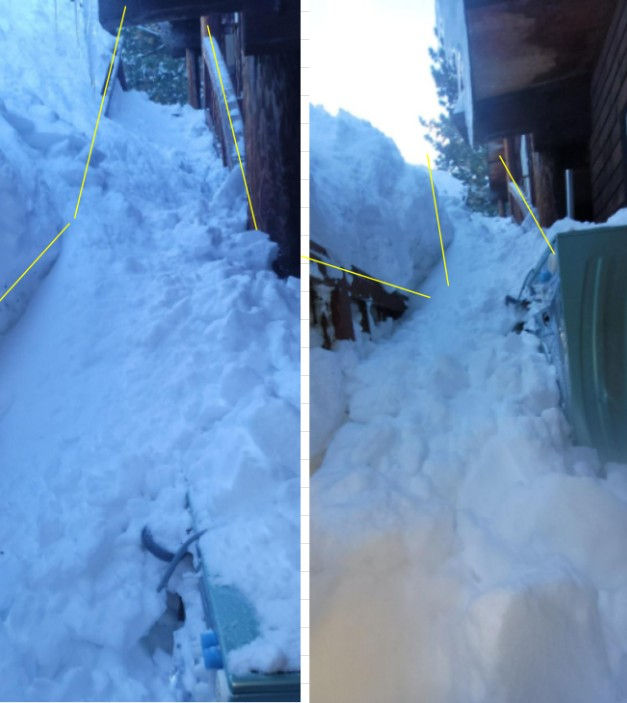
Wall of Snow from Lower Unit Front Door
The images below are taken from the lower deck, looking upward toward the accumulated snow. The yellow lines indicate the locations of the deck and stair railings (see above for corresponding heights of 12'4", 15'3", and 17'5").
As shown, snow accumulation rises well above these reference points—exceeding railing heights by approximately 4–5 feet in certain areas and increasing further up the slope. This snow is positioned on a steep hillside (approximately 73 degrees) directly above the structure.
These images illustrate the volume of snow being retained in this area and its proximity to the building and structural elements.
☀️ Snow Conditions in This Location
This area is south-facing and receives significant sun exposure, resulting in frequent melt cycles. Under typical conditions, natural snowfall accumulation in this location would be expected to remain limited, generally not exceeding approximately 4 feet.
Due to solar exposure and roof overhang, snow would not normally accumulate in large volumes directly against the deck, structural supports, or building.
📌 Observed Conditions
The images demonstrate how snow collected from surrounding roadways and parking areas is directed down the slope and accumulates against the structure, surrounding the deck and support elements.
In the lower-right image, the yellow reference line also indicates the height at which snow was positioned directly against the railings and building when viewed from the side.

Deck and Stair Heights Above Ground
The images below provide scale for the deck and stair structures at the 331 building.
-
Lower deck railing height: 12'4"
-
Mid-stair elevation: 15'3"
-
Upper deck railing height: 17'5"
As shown, snow accumulation in this area rises to and, at times, exceeds these elevations—surrounding and overtopping the deck and stair system.
This area is south-facing and receives significant sun exposure. Under typical conditions, natural snowfall in this location would be expected to remain relatively limited, generally not exceeding approximately 4 feet.

Stair & Deck From Street
This image shows the deck and stair access from the street to both the upper and lower units.
As shown, the structure appears to be out of level, with visible distortion along the deck and stair system. These conditions are observed in areas where significant snow accumulation has occurred adjacent to the structure. These changes are not typical of a level deck system and raise concerns regarding structural alignment.
Post and Pier Foundation
The building is supported by a post-and-pier (post-and-beam) system, with structural loads carried through individual vertical posts (highlighted in yellow below).
As shown, these posts are positioned in areas where significant snow accumulation has occurred directly against the structure.
In the third image, visible deformation and lateral displacement can be observed in the deck support posts, consistent with lateral loading conditions.